
Una nota sobre el método. Todo lo que sigue está sostenido en cifras de aduana verificables y en documentos públicos, no en opiniones. Cuando algo sea interpretación mía, lo digo con esas palabras. Lo hago así porque cuando alguien va a tomar una decisión con su dinero o con su tiempo, merece saber qué es hecho y qué es lectura.
Before we start, a warning about what this is. It is not an opinion piece. It is a map of the value chain as it operates today, with verifiable customs figures, and it ends with seven concrete business keys: where the money is, where the jobs are, what it takes to enter and where to begin.
Voy a empezar con el dato más incómodo de esta década, y le pido que lo lea dos veces porque contiene toda la historia.
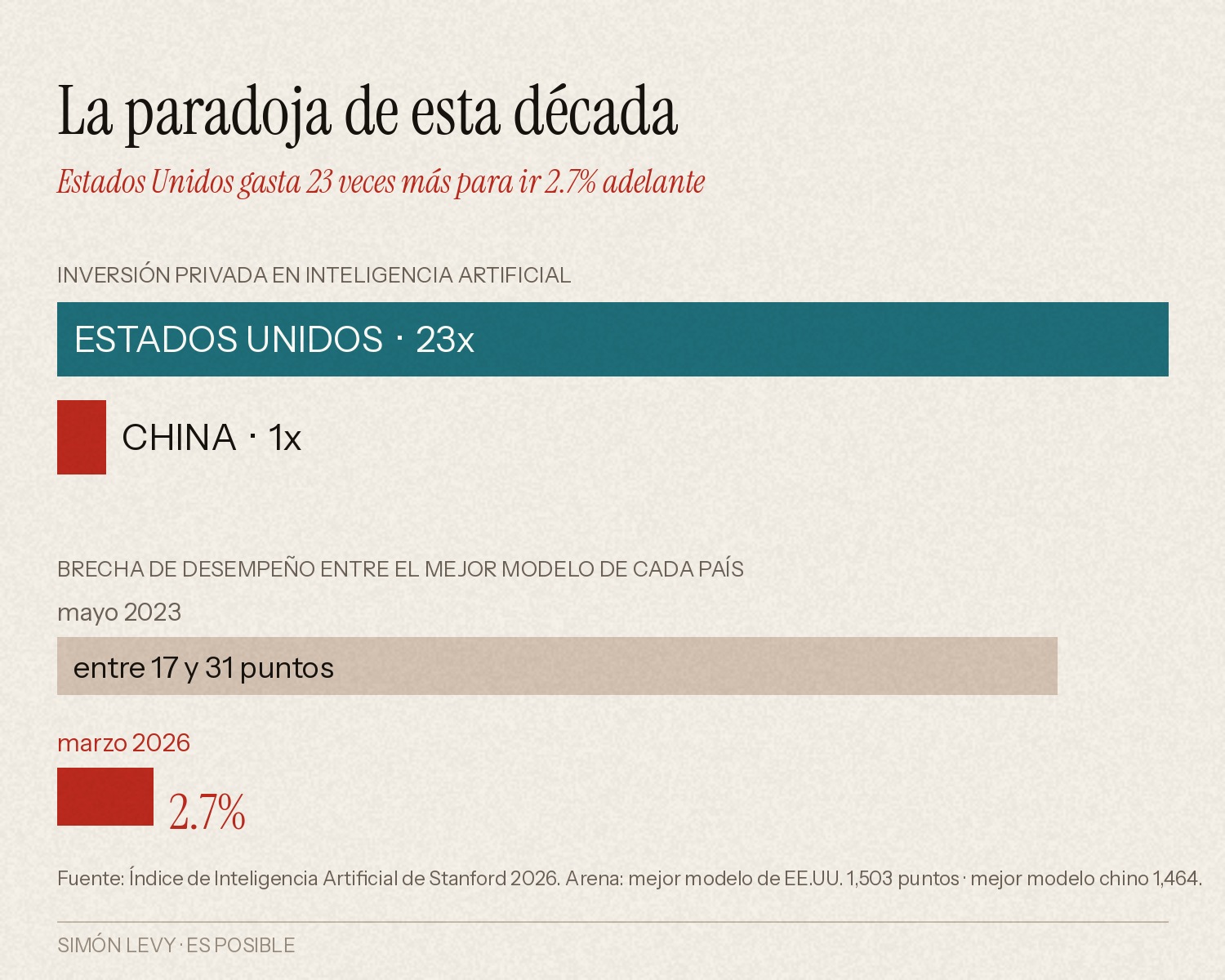
El Índice de Inteligencia Artificial de Stanford, que es el documento más citado del mundo en este tema, publicó su edición 2026. En mayo de 2023, la brecha de desempeño entre el mejor modelo estadounidense y el mejor modelo chino era de entre 17 y 31 puntos porcentuales, según el examen. Era un abismo. En marzo de 2026 la brecha es de 2.7 por ciento.
El mejor modelo del mundo hoy es estadounidense y marca 1,503 puntos en la arena donde se comparan. El mejor modelo chino, de ByteDance, la dueña de TikTok, marca 1,464. Treinta y nueve puntos de diferencia.
Ahora el otro lado de la moneda, que es donde se pone interesante. Estados Unidos gasta veintitrés veces más que China en inversión privada de inteligencia artificial. Las cuatro grandes empresas tecnológicas estadounidenses van a gastar este año alrededor de 630 mil millones de dólares. Solo Amazon presupuestó 200 mil millones. Del lado chino, la suma de Alibaba, Tencent, ByteDance y Baidu ronda los 102 mil millones.
Y para que entienda por qué esto no es un dato de tecnología sino de civilización, hay que retroceder ciento ochenta y siete años.
En 1839 Gran Bretaña le vendía opio a China para pagar el té y la seda que le compraba. Cuando el emperador prohibió la droga, Londres mandó la flota. China perdió, entregó Hong Kong, abrió sus puertos por la fuerza y firmó el primero de los tratados que en Pekín todavía se enseñan con un nombre exacto: el siglo de la humillación. En esos mismos años, en Manchester y en Pittsburgh, se estaba inventando el mundo moderno. China no se subió a la revolución industrial. La revolución industrial se le subió encima.
Guarde esa idea, porque explica el comportamiento chino de hoy mejor que cualquier análisis de mercado. Un país que perdió el siglo XIX por llegar tarde a una tecnología no va a llegar tarde a la siguiente. No es ambición económica. Es una cuenta pendiente de casi dos siglos.
El candado que ya se rompió, y pasó en nuestra región
Le voy a dar un ejemplo de este mismo año, y lo tomo de México porque es donde la cifra es más clara, pero el patrón se repite en toda América hispana: en Chile, en Perú, en Colombia y en Brasil las marcas chinas ganaron participación al mismo tiempo.
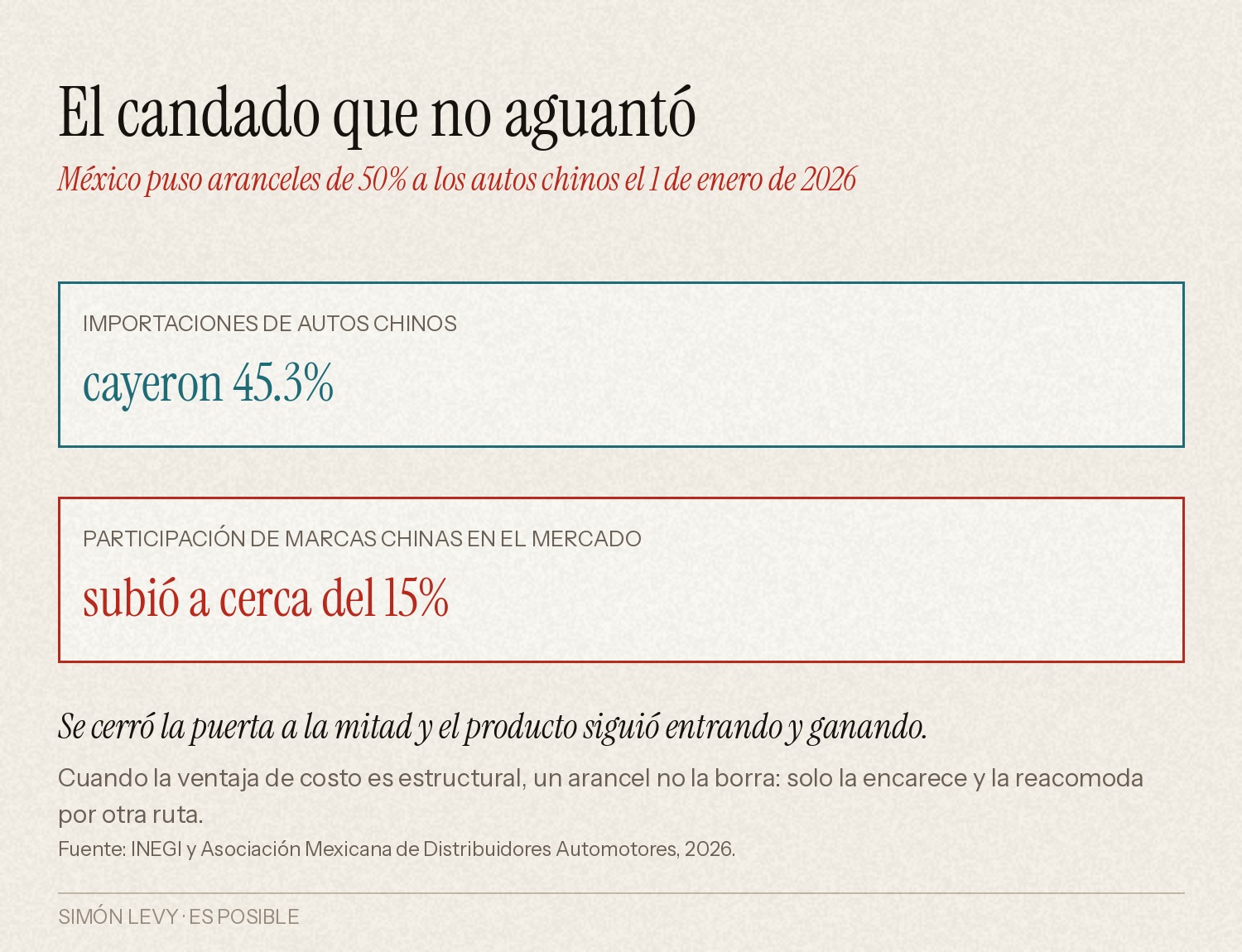
El 1 de enero de 2026 México aplicó aranceles de hasta 50 por ciento a los autos y productos chinos, dentro del Plan México. Cincuenta por ciento. Un muro. ¿Qué pasó? Las importaciones cayeron 45.3 por ciento y las ventas de las marcas chinas siguieron subiendo hasta cerrar con alrededor del 15 por ciento del mercado mexicano.
Léalo otra vez. Se cerró la puerta a la mitad y el producto siguió entrando y ganando. Porque cuando la ventaja de costo es estructural y no coyuntural, un arancel no la borra: solo la encarece un poco y la reacomoda por otra ruta.
Y aquí paro la parte abierta, porque lo que sigue es el desarme completo: las diferencias concretas entre el modelo chino y el estadounidense explicadas sin jerga, quiénes son los jugadores reales, por qué el candado de los chips tiene fecha de caducidad, el terreno donde China ya ganó y casi nadie lo ha notado, el nuevo reparto del mundo que se está negociando sin mapa público, qué le va a pasar profesión por profesión a la gente en México y en América Latina, cómo va a quedar el gobierno y la burocracia, los siete factores que deciden quién gana, y las oportunidades concretas para una empresa que sepa leer esto a tiempo.
Let me start with the most uncomfortable figure of this decade, and read it twice because it contains the whole story.
Stanford's AI Index, the most cited document in the world on this subject, published its 2026 edition. In May 2023, the performance gap between the best American model and the best Chinese model was between 17 and 31 percentage points depending on the test. It was a chasm. In March 2026 the gap is 2.7 percent.
The best model in the world today is American and scores 1,503 points in the arena where they are compared. The best Chinese model, from ByteDance, the owner of TikTok, scores 1,464. Thirty-nine points apart.
Now the other side of the coin. The United States spends twenty-three times more than China on private AI investment. The four big American tech firms will spend around 630 billion dollars this year. Amazon alone budgeted 200 billion. On the Chinese side, Alibaba, Tencent, ByteDance and Baidu together come to about 102 billion.
And to understand why this is not a technology story but a civilizational one, you have to go back one hundred eighty-seven years.
In 1839 Britain was selling opium to China to pay for the tea and silk it bought. When the emperor banned the drug, London sent the fleet. China lost, handed over Hong Kong, had its ports forced open and signed the first of the treaties Beijing still teaches under an exact name: the century of humiliation. In those same years, in Manchester and Pittsburgh, the modern world was being invented. China did not board the industrial revolution. The industrial revolution ran over it.
Hold that idea, because it explains Chinese behavior today better than any market analysis. A country that lost the nineteenth century by arriving late to one technology is not going to arrive late to the next. This is not economic ambition. It is a two-century-old unpaid bill.
The lock that already broke, and it happened in our region
Let me give you an example from this very year. I take it from Mexico because the figure is clearest there, but the pattern repeats across Spanish-speaking America.
On January 1, 2026 Mexico applied tariffs of up to 50 percent on Chinese cars and goods under Plan México. Fifty percent. A wall. What happened? Imports fell 45.3 percent and sales of Chinese brands kept rising, closing at around 15 percent of the Mexican market.
Read it again. The door was half shut and the product kept coming in and winning. Because when a cost advantage is structural rather than circumstantial, a tariff does not erase it: it just makes it slightly more expensive and reroutes it.
Here I stop the open section. What follows is the full breakdown: the concrete differences between the Chinese and American models explained without jargon, who the real players are, why the chip lock has an expiration date, the terrain where China has already won and almost nobody noticed, the new partition of the world being negotiated without a public map, what will happen profession by profession in Mexico and Latin America, how government and bureaucracy will end up, the seven factors deciding who wins, and the concrete opportunities for a company that reads this in time.
Óigalo del propio Departamento de EstadoHear it from the State Department itself
Todo lo que argumento en este ensayo descansa en una premisa: que esto no es una competencia comercial sino un choque civilizatorio. No hace falta que me crea a mí. Aquí está el secretario de Estado Marco Rubio planteándolo en sus propios términos.Everything I argue here rests on one premise: that this is not commercial competition but a civilizational clash. You do not have to take my word for it. Here is Secretary of State Marco Rubio framing it in his own terms.

«Sabemos que China quiere ser la potencia líder del mundo. Pero sabemos que quieren que eso suceda a costa de Estados Unidos, y no lo vamos a permitir.»
«We know China wants to be the world's leading power. But we know they want that to happen at the expense of the United States, and we are not going to let that happen.»
Marco Rubio · Secretario de Estado de Estados UnidosMarco Rubio · U.S. Secretary of StateTraducción del autor a partir del video. Se reproduce el sentido de la declaración, no una transcripción oficial palabra por palabra.Author's translation from the video. It conveys the sense of the statement, not an official word-for-word transcript.
El video está en inglés. Para verlo con subtítulos, toque el engrane ⚙ del reproductor, entre a Subtítulos y elija Traducir automáticamente → Español. Le advierto que la transcripción automática de YouTube comete errores; lo que importa del video es el planteamiento, y el argumento completo está escrito abajo.The video is in English. For captions, tap the ⚙ gear in the player, go to Subtitles and pick your language. Note that YouTube's automatic transcription makes errors.
Marco Rubio, secretario de Estado de EE.UU. · Video alojado en el canal de Simón Levy en YouTubeMarco Rubio, U.S. Secretary of State · Video hosted on Simón Levy's YouTube channel
Material de dominio público de un funcionario estadounidense en ejercicio de su cargo. Se reproduce mediante el reproductor oficial de YouTube. La selección del fragmento y su lectura son responsabilidad del autor.Public domain material from a U.S. official acting in office, embedded via the official YouTube player. The excerpt selection and its interpretation are the author's responsibility.
Lo que sigue no lo va a leer en ningún otro lado
Detrás de este punto está el ensayo completo: por qué esta es la pelea que define el siglo y qué le va a pasar concretamente a su trabajo, a su empresa y a su país.
Con cuatro herramientas que construí para que lo vea usted mismo:
- Servidores contra automóviles · el vuelco de 2026, la correlación de 0.97 que revela la trampa, y las dos señales de esta semana: la concentración de Amazon y las imágenes satelitales falsas de Google
- Las cuatro curvas del siglo · la convergencia, la tijera del gasto contra la ventaja, la explosión de los humanoides y las tres curvas de México sobre el mismo plano
- Comparador de los dos modelos · cerebro contra cuerpo, dimensión por dimensión, y qué pasa si cada apuesta gana
- El nuevo Tordesillas · cómo se está repartiendo el mundo: América, África, sudeste asiático, Taiwán y Europa, con la evidencia de cada caso
- Su oficio en el tablero · ocho profesiones con nivel de riesgo, plazo estimado y qué sí protege
- El marcador de los siete factores · mueva las variables y vea quién gana y por qué
Más el dato que me obligó a corregir mi propia tesis: las exportaciones mexicanas de infraestructura de inteligencia artificial superaron por primera vez a las automotrices, con 105,800 millones de dólares en cinco meses. Qué significa de verdad y por qué no cancela la advertencia.
Más el terreno donde China ya ganó y nadie lo notó, por qué el candado de los chips tiene fecha de caducidad, cómo va a quedar el gobierno y la burocracia, y las cinco oportunidades concretas donde está el dinero para una empresa que lea esto a tiempo.
No lo escribió una redacción. Lo escribí yo, cruzando resultados electorales, fallos judiciales y registros de aduana. Acceso permanente, en español e inglés, con audio completo de 81 minutos.
$4.99 USD · una sola vez
What follows you will not read anywhere else
Behind this point sits the full essay: why this is the fight that defines the century and what will concretely happen to your job, your company and your country.
With four tools I built so you can see it yourself:
- Servers versus cars · the 2026 flip, the 0.97 correlation that reveals the trap, and this week's two signals
- The four curves of the century · convergence, the scissors, the humanoid explosion and Mexico on the same plane
- The two-model comparator · brain versus body, dimension by dimension
- The new Tordesillas · how the world is being divided, with evidence for each case
- Your trade on the board · eight professions with risk level, estimated timeline and what actually protects you
- The seven-factor scoreboard · move the variables and see who wins and why
No newsroom wrote this. I wrote it, cross-referencing electoral results, court rulings and customs records. Permanent access, Spanish and English, with the full 81 minute audio.
$4.99 USD · one time
Las dos maneras de construir el futuroTwo ways of building the future
Estados Unidos está construyendo un cerebro. China está construyendo un cuerpo. Uno apostó a la máquina que razona mejor que cualquier humano, financiada por capital privado que compite a muerte. El otro apostó a meter inteligencia suficientemente buena dentro de todo lo que se mueve: fábricas, autos, robots, cámaras, grúas, tractores. Y en 2024 instaló cerca de trescientos mil robots industriales, la mitad de todo el planeta, mientras Estados Unidos instalaba treinta y cuatro mil.The United States is building a brain. China is building a body. One bet on the machine that reasons better than any human, funded by private capital competing to the death. The other bet on putting good-enough intelligence inside everything that moves.
Desbloquea la investigación completaUnlock the full investigation
Pago único. Acceso permanente en este dispositivo.One-time payment. Permanent access on this device.
Desbloquear · $4.99 USDUnlock · $4.99 USDVerifícalo tú mismo · Fuentes públicasVerify it yourself · Public sources
- Universidad de Stanford · Índice de Inteligencia Artificial 2026Stanford University · AI Index Report 2026
- McKinsey Global Institute · Inversión productiva por país, junio 2026McKinsey Global Institute · Net productive investment by country, June 2026
- Federación Internacional de Robótica · Estadísticas mundiales de robotsInternational Federation of Robotics · World Robotics statistics
- BCG · La división global de la inteligencia artificialBCG · The global AI divide
- INEGI · Industria automotriz y comercio exterior de MéxicoINEGI · Mexican auto industry and foreign trade
- AidData · Financiamiento chino en América LatinaAidData · Chinese financing in Latin America
Investigación y análisis: Simón Levy. Publicado por Es Posible. Apoya este trabajo en Research and analysis: Simón Levy. Published by Es Posible. Support this work at patreon.com/SimonLevyMX · diario.simonlevy.mx